
PM Awas Gramin Amount 2026: How Much Money You Get and in Which Instalment
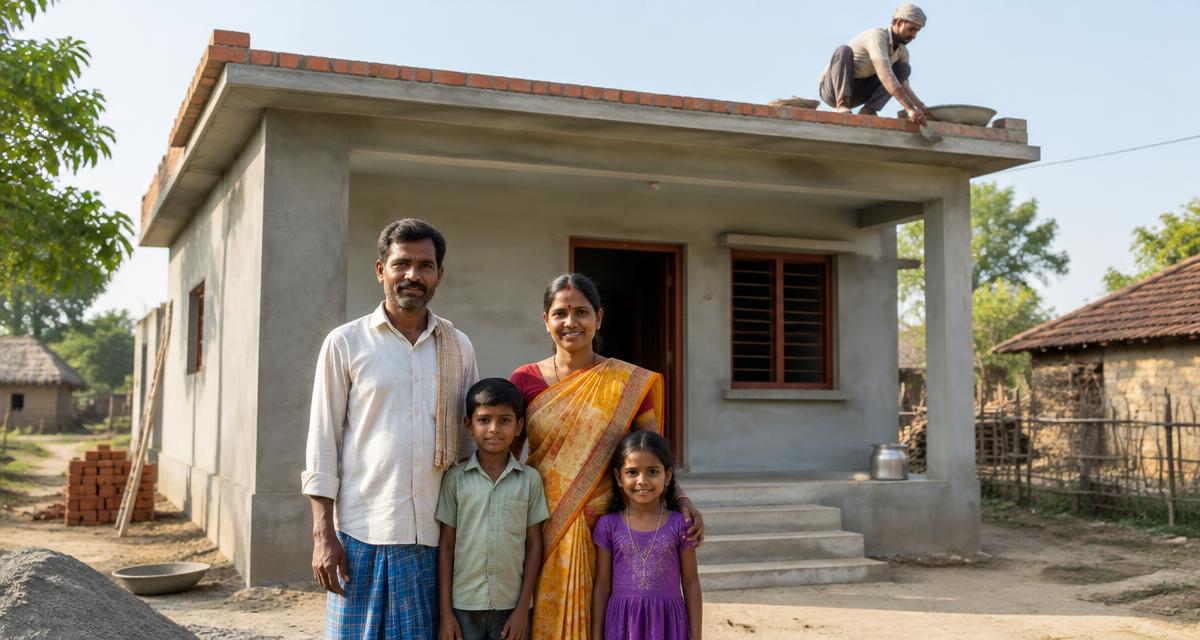
Under PM Awas Yojana–Gramin, the house assistance is ₹1.20 lakh in plain areas and ₹1.30 lakh in hilly states, difficult areas and IAP districts. On top of this, the family can get 90–95 days of unskilled wages under MGNREGA and ₹12,000 for a toilet through SBM-G, MGNREGA or another dedicated source. The money comes in instalments that are released only after each construction stage is geo-tagged and verified.
Checked on 13 October 2026 against the PMAY-G portal (scheme framework), the public AwaasSoft reports and PIB release 2112200. The number of instalments and the share released in each one is fixed by each State; we describe the common pattern and tell you where to read your own State's exact schedule.
Answer 5–7 simple questions and get your eligibility score in 2 minutes.
Check eligibility now →At a glance
- Plain areas
- ₹1,20,000 house assistance
- Hilly / difficult / IAP areas
- ₹1,30,000 house assistance
- MGNREGA labour
- 90 person-days (95 in hilly/IAP areas) of unskilled wages
- Toilet support
- ₹12,000 via SBM-G, MGNREGA or other source
- Minimum house size
- 25 sq m including a hygienic cooking space
- Payment mode
- Direct to the beneficiary's bank account through AwaasSoft/PFMS
What is it?
PMAY-G is the Centre's rural housing scheme for families who are houseless or live in kutcha or dilapidated houses. The funding for the house is shared between the Centre and the State — 60:40 in most States, and 90:10 in the North-Eastern and Himalayan States — but for the beneficiary it arrives as one combined amount, split across instalments. The house must be at least 25 square metres, including a dedicated area for hygienic cooking, and it is built by the family itself, not by a contractor.
Benefits
Total support is more than the headline ₹1.20 lakh. For an illustrative plain-area house: ₹1,20,000 assistance + 90 days of MGNREGA unskilled wages (the daily rate depends on your State's notified MGNREGA wage) + ₹12,000 for a toilet. Families who want a bigger house can also take an optional institutional loan; the scheme framework allows beneficiaries to seek such a loan from a bank, and this is fully voluntary. Masons, technical guidance and house design typologies are supported locally, so families can build a sturdy house suited to their region.
Eligibility criteria
- ✓Your name must be on the approved PMAY-G beneficiary list for your Gram Panchayat (from SECC 2011 or Awaas+ survey data, verified by the Gram Sabha)
- ✓The house must be sanctioned in AwaasSoft before any instalment is released
- ✓Your bank or post-office account must be correct and Aadhaar-seeded for the payment to reach you
- ✓Each later instalment needs a geo-tagged photo of the completed stage and verification by the field functionary
- ✓To get MGNREGA wages for your own house, the family needs an active MGNREGA job card
Documents required
- ✓PMAY-G registration number / sanction order
- ✓Aadhaar of the beneficiary
- ✓Bank or post-office passbook in the beneficiary's name
- ✓MGNREGA job card (for labour wages)
- ✓Consent for Aadhaar use as required by the State
How to apply — step by step
- Find your registration number using our PMAY-G registration-number guide or from the panchayat
- On pmayg.dord.gov.in open Stakeholders → IAY/PMAYG Beneficiary and search by registration number to see sanction and payment details
- Match each credited payment to a construction stage — foundation/plinth, lintel/roof level, completion — the exact stages are set by your State
- Before each stage, ask the Gram Rozgar Sahayak or Awaas Sahayak to upload the geo-tagged photo through AwaasApp; no photo, no next instalment
- Check your MGNREGA job card on nrega.nic.in to confirm the 90/95 days of work on your house are recorded and paid
- If an instalment is pending even after the stage is uploaded, check the FTO/PFMS status, then raise it at the block PMAY-G desk
Important dates
There is no national date for instalments; each is released after the previous stage is verified. States usually expect a house to be completed within about 12 months of sanction, so build steadily and keep photos updated.
Common mistakes to avoid
- ✓Thinking ₹1.20 lakh comes in one payment — it is always staged
- ✓Starting the next stage before the earlier geo-tag is uploaded, which delays money
- ✓Paying anyone to “release” an instalment — no fee is required
- ✓Ignoring the MGNREGA wage part, which is a real extra benefit
- ✓Changing the bank account without informing the block office
Frequently asked questions
How much money is given under PM Awas Gramin in 2026?
₹1.20 lakh in plain areas and ₹1.30 lakh in hilly States, difficult areas and IAP districts, plus 90–95 days of MGNREGA wages and ₹12,000 toilet support.
How many instalments are there?
Most States release the amount in three instalments linked to construction stages, but the exact number and split is decided by your State. Ask the block office for your State's schedule.
Can I get the full amount in advance?
No. Each later instalment is released only after the previous stage is geo-tagged and verified.
Is the toilet money separate?
Yes. ₹12,000 for a toilet comes through SBM-G, MGNREGA or another dedicated source, in addition to the house assistance.
Is a bank loan compulsory?
No. An institutional loan is optional and only for families who want to build a larger house.
Answer 5–7 simple questions and get your eligibility score in 2 minutes.
Check eligibility now →